
The Mind Was Built for Less
Constant consumption does not equal understanding. A mind that receives everything ends up holding very little.

Try a small experiment at the end of any ordinary day. Sit quietly for a few minutes and try to remember what actually crossed your mind in the hours just past. Push aside the news you scanned, the messages you answered, the videos that played in the background.
Now try to find the thoughts that were truly yours. The reflections you actually had.
For many of us, this experiment brings a strange and uncomfortable silence.
Your day was full. Hundreds of inputs came your way. You absorbed opinions, reacted to messages, processed fragments. But by evening, almost none of it remains. Nothing was truly considered. Nothing settled into real understanding. The day passed through you rather than you living it.
This is the quiet new reality of modern mental life.
We call it distraction. But the real issue is saturation. Your attention overflows like a glass that can hold no more. Anything new can’t truly be held. It just passes through and leaves residue behind.
Modern information is designed for exactly this. Frictionless intake. Endless scrolling. Waves of notifications. Apps that refresh before you reach the bottom. Content made to provoke a reaction, then instantly replaced by more.
Mind after mind has been trained to consume at this pace without ever stopping to ask what is actually entering.
A quiet philosophical loss lies beneath all of this.
For centuries, serious thinkers have seen the mind as something that must do more than simply receive. Receiving is easy. It takes no effort.
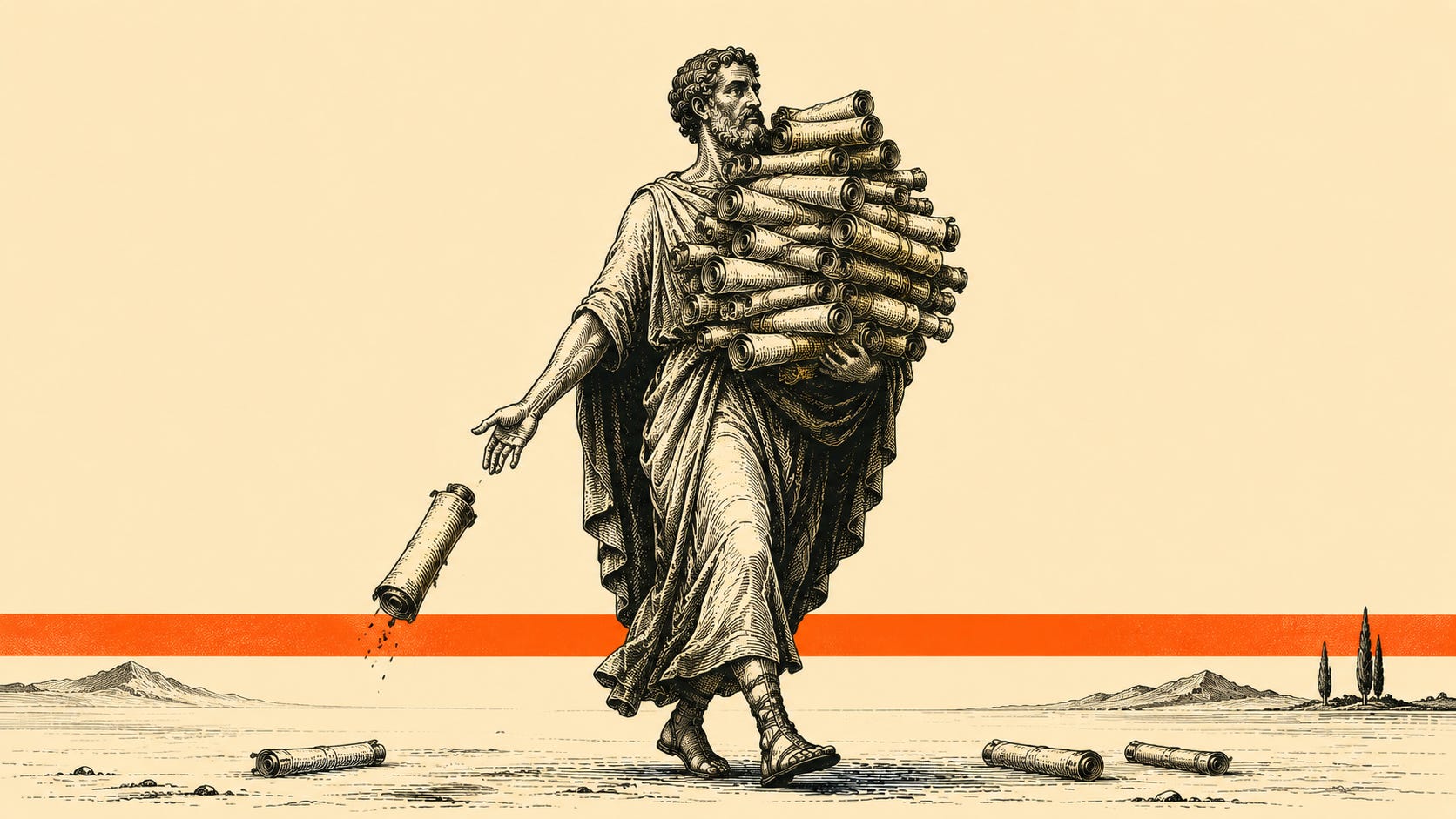
The real work is judgment. It means choosing what matters and what does not. Holding ideas up to scrutiny before letting them shape you. Epictetus, teaching from a small room in second-century Rome, saw this as the central task of a thinking person.
Every impression that arrives must be examined before you let it move you.
Apply that idea to modern life and the picture grows uncomfortable.
How many impressions in an average day actually get examined? How many are simply absorbed instantly without question?
Most of what enters your mind goes unchecked. Most of what shapes your daily emotions was never chosen. Hour by hour, you are being shaped by content selected by algorithms and designed for engagement. And this is being called normal life.
What happens to such a mind is something subtler than chaos. A flattening. Everything starts to feel the same weight. Outrage, amusement, grief, minor news all arrive at the same rhythm, in the same scroll, with the same feedback. The mind loses its sense of proportion.
And without proportion, judgment cannot truly function. You can still react to things. But weighing them properly becomes much harder.
The argument is simple. Constant consumption does not equal understanding. A mind that takes in everything ends up holding very little. The ability to think clearly, to act with intention, to live with proportion, depends on something modern life rarely encourages: the discipline of refusing what does not deserve to enter.
If you’re not a paid subscriber, we encourage you to upgrade your subscription, so that you can make the most of this publication. It won’t cost much and we can keep up the good work. Thank you already for all of your support. Now, let’s get started!
