
The Goal is the Problem
The aspiration to join the top 1% in twelve months is everywhere. The Stoics would find it not merely misguided, but philosophically incoherent. Here is why.

Imagine two people who follow the exact same regimen for a year.
They wake before sunrise. They read deeply instead of scrolling. They exercise without exception. They build something with their own hands over two focused hours every morning.
At the end of twelve months, one of them has broken through, gained an audience, and made real money.
The other has nothing external to show for it.
Markets shifted. Timing was wrong. The algorithm did not cooperate.
Now ask: which one lived better that year?
For most people shaped by contemporary ambition, the answer feels obvious. The one with results lived better. The other was, at best, unlucky.
But for the Stoic philosophers, this intuition represents one of the deepest errors a person can make about the nature of a good life. It is not merely a strategic mistake. It is a confusion about what kind of thing human flourishing actually is.
The mentality of becoming a top 1% performer within a fixed period is structurally incompatible with Stoic ethics, not because the practices it recommends are wrong, but because the goal it names belongs to the wrong category entirely. The Stoics called this category “externals,” and they spent centuries arguing that attaching your wellbeing to externals is the root cause of human misery, regardless of whether those externals are poverty or wealth, obscurity or fame.
Through this piece, we will argue this by examining the Stoic framework of value, then turning to three specific tensions where the top-1% mentality breaks with it, before considering what a genuinely Stoic ambition might look like.
If you’re not a paid subscriber, we encourage you to upgrade your subscription, so that you can make the most of this publication. It won’t cost much and we can keep up the good work. Thank you already for all of your support. Now, let’s get started!
I. THE FRAMEWORK
What the Stoics actually valued
The Stoics divided the world into two categories with a precision that still feels almost violent in its clarity. There are things “up to us” and things “not up to us.” Epictetus, the former slave who became one of the most influential philosophers of the ancient world, opens his Enchiridion with this distinction and never lets go of it.
“Seek not that the things which happen should happen as you wish; but wish the things which happen to be as they are, and you will have a tranquil flow of life.”
— EPICTETUS, ENCHIRIDION §8
What is up to us: our judgements, our intentions, our desires, our responses to what happens. What is not up to us: our bodies, our reputations, wealth, the opinions of others, and outcomes of any kind. The diagram below makes this structure visible and shows precisely where the top-1% ranking sits within it.
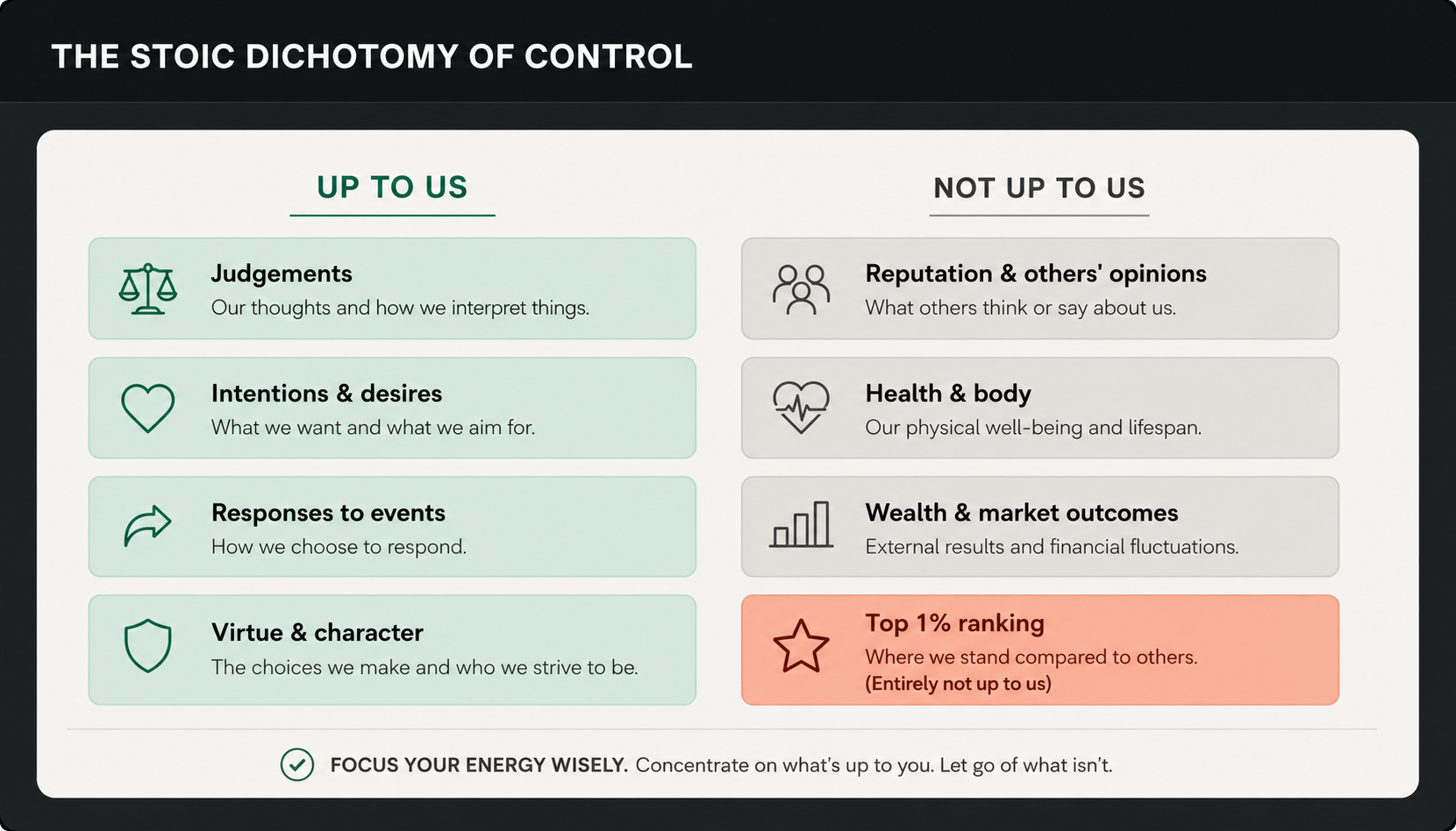
This is not passive resignation. The Stoics were intensely active. Marcus Aurelius spent most of his reign on military campaigns. Seneca wrote with fierce urgency about how to use time. Epictetus insisted that students work at philosophy as rigorously as any craft.
But the direction of that activity is inward.
The effort goes toward becoming a person who thinks clearly, acts justly, and maintains equanimity regardless of circumstances. The results, in the external world, are genuinely not the point.
From this follows the Stoic doctrine of “preferred indifferents.”
Health, wealth, reputation, and social standing are not bad. Seneca’s personal fortune was enormous. But these things are morally neutral. They can be preferred, pursued even, so long as you hold them lightly, the way you might prefer a window seat on a train without making your happiness conditional on getting one.
The moment wealth becomes the thing your sense of self depends on, it has been elevated from “preferred indifferent” to a false good, and you have handed your peace of mind to forces outside your control.
Virtue, for the Stoics, was the only genuine good.
Not virtue in the watered-down modern sense of being polite, but virtue in the Greek sense of arete: excellence of character, practical wisdom, justice, courage, and self-control. These are the only things that cannot be taken from you, because they live entirely within the domain of what is up to you.
