
No One Is Invincible
A conversation about power, impermanence, and the art of remaining human.

Somewhere right now, a man whose name you would recognize from a newspaper headline is lying awake at 3 am. His decisions have moved markets, reshaped borders, and sent ripples through the lives of people he will never personally meet. He has security details, lawyers on retainer, and a wardrobe managed by someone else. He controls more than almost any human being who has ever lived. And yet, right now, at 3 am, the ceiling above him does not care about any of that. The dark gives him no special treatment. His chest tightens the same way yours does. His thoughts spin in the same grooves. He is, in this particular moment, exactly as human as you are.
We tend to forget this. We have been trained, over many centuries and across almost every culture on earth, to treat certain people as if they occupy a different category of existence. The king, the general, the CEO, the strongman who seems to bend the world toward his will. We shrink a little when we are near them. We overestimate their solidity and underestimate our own. And somewhere along the way, we start to absorb their mythology as reality.
But mythology is not reality. It is a story, carefully maintained, serving a very specific purpose. And the purpose is usually to keep you from noticing that the person performing it is mortal, fallible, afraid, and operating with far less certainty than the performance suggests.
This essay is an attempt to give you a more useful way of thinking about all of this. Not a cheap comfort, not an invitation to resent the powerful, but a genuine rethinking of what invincibility is, what it has ever actually meant, and why letting go of the wish to have it might be the most liberating thing you do this year.
What you are about to read draws from some old and unfashionable places. From a philosophy developed by people who had seen real suffering up close and were trying to figure out how to stay upright anyway. From history that predates the internet and the news cycle, and the particular anxiety of being watched, ranked, and compared that modern life has specialized in from religious texts and ancient letters and the margins of manuscripts written by people who understood, in their bones, that nothing lasted and were trying to figure out what to do with that knowledge, rather than drown in it.
You do not have to agree with everything. You have to sit with it for a while and see what it stirs up. That is all philosophy has ever asked of anyone.
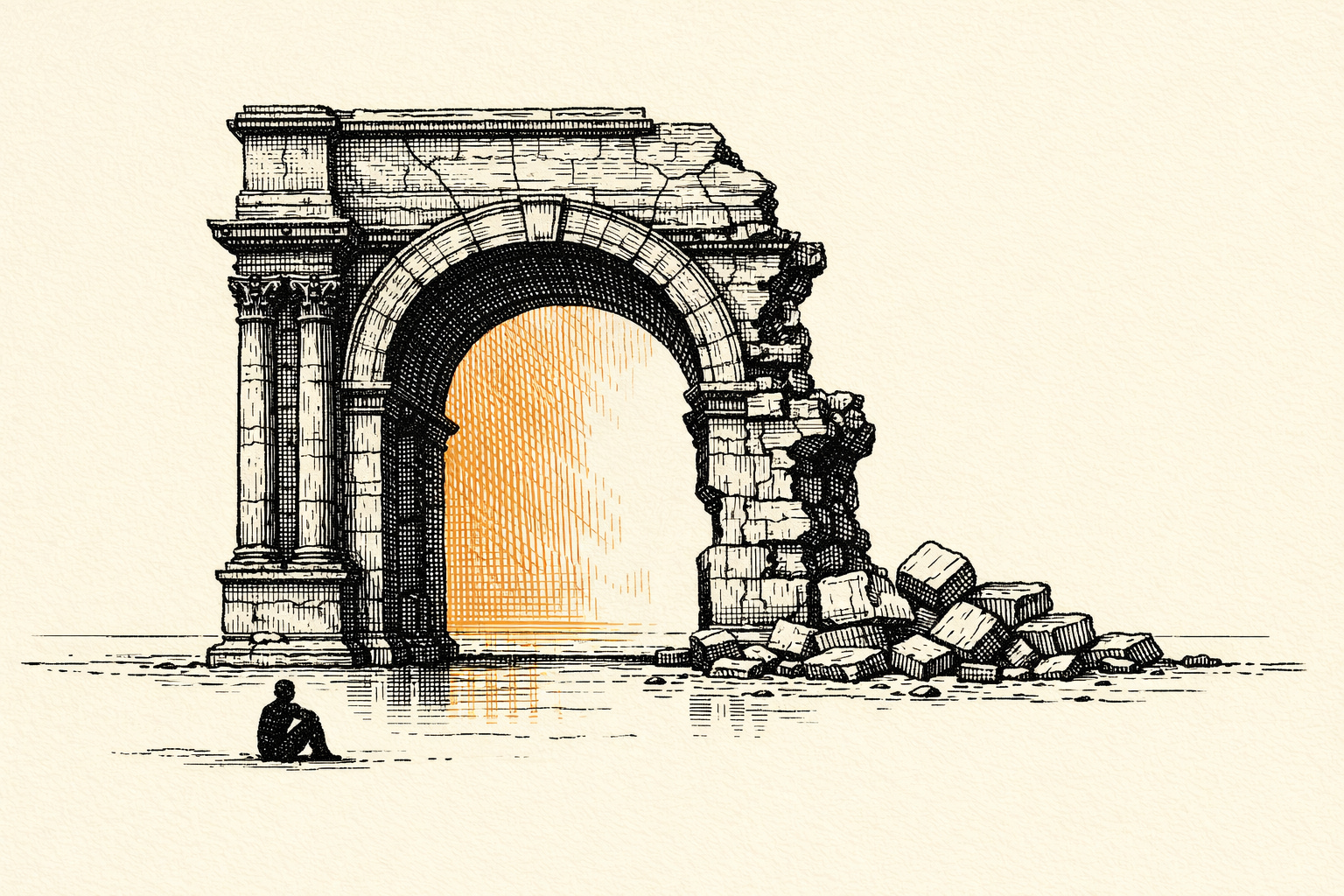
The Story We Tell About the Rock
In ancient Persia, some rulers had a tradition of having a servant whisper in their ear during moments of great triumph. The message was always the same: remember you are mortal. The point was not to dampen the joy. It was to keep the ruler from making the most dangerous mistake available to a person in power, which is believing the power is a permanent property of their nature rather than a temporary condition of their circumstances.
That tradition died out. And look at what replaced it. We now live in a world where the powerful are encouraged, at every turn, to believe that their position reflects something essential, earned, and stable about who they are. The mythology of the self-made person. The narrative of deserved dominance. The assumption that if you are at the top, you must have something the rest of us lack.
This story is seductive because it is partly true. Hard work matters. Skill matters. Character matters. But it is also catastrophically incomplete, because it leaves out the enormous role of timing, circumstance, inherited advantage, and the plain randomness of a universe that has never once promised anyone that effort will be rewarded proportionally.
The Bhagavad Gita, written somewhere between 500 and 200 BCE and still one of the most psychologically sophisticated documents humans have ever produced, opens with a warrior prince named Arjuna who looks out at the battlefield before him and collapses. He suddenly sees the full cost of what he is about to do, sees the faces of the people on both sides who will not survive it, and cannot make himself move forward. His guide, Krishna, does not tell him to toughen up or stop being weak. Instead, what follows is one of the oldest recorded attempts to teach a human being to engage fully in the world while not being destroyed by attachment to outcomes.
How to do the work without mistaking the work for the whole story of who you are.
“You have a right to perform your prescribed duties, but you are not entitled to the fruits of your actions.”
— Bhagavad Gita, 2.47
This is not passive resignation. It is a radical act of psychological clarity. The person in the mud who cannot accept that they are in it will exhaust themselves thrashing. The person at the top who cannot accept that the top is temporary will spend all their energy defending a position that was always going to shift.
Both of them are suffering from the same mistake: they have made their inner state entirely dependent on an outer condition they do not fully control.
What the Thread Actually Is
There is a very old distinction, common to several philosophical traditions, between two categories of experience. What is within your power, and what is not. The distinction sounds simple. It is actually hard to live by, because the things outside your power are exactly the things that feel most urgent and most central to your happiness.
Think about what occupies the majority of your mental energy on any given week.
Other people’s opinions of you. Whether the plan you set in motion will work out. How the economy will behave. Whether the person you love will stay. Whether the effort you are putting in will be recognized. Almost every item on that list belongs to the second category—things outside your direct control.
The philosopher Zeno of Citium, who founded the school of thought we now call Stoicism around 300 BCE in Athens, came to this understanding after a shipwreck. He lost everything: his cargo, his livelihood, his plans for the future. According to the account left by Diogenes Laertius, Zeno walked away from that wreck and eventually said it was the most fortunate thing that had ever happened to him because losing everything that fast taught him, with absolute clarity, what was actually his to keep.
And it turned out to be very little, and also more than enough.
“Seek not that the things which happen should happen as you wish; but wish the things which happen to be as they are, and you will have a tranquil flow of life.”
— Epictetus, Enchiridion
That is not a quote from the inner circle of Stoic celebrities. That is the core operating principle of an entire way of living, available to you right now, today, regardless of what your current circumstances look like.
The task is not to control what happens. The task is to engage honestly with what happens, respond with your best judgment, and then release the outcome. Not once. Every day. Sometimes every hour.
The River Always Curves
Every civilization that has ever existed believed, at some point, that it was the final one. That it had figured out the arrangement that would last. The Assyrians built libraries intended to last forever. The Aztecs had a cosmology in which their particular empire was necessary for the sun to keep rising. The British, within the living memory of people still alive today, controlled a quarter of the earth’s surface and genuinely believed the arrangement was natural and permanent.
Every single one of them was wrong.
Why? Because nothing complex and contingent has ever been permanent.
The river always curves. The current always shifts. This is not pessimism. It is just the geological record applied to human affairs.
The Islamic scholar Ibn Khaldun, writing in the 14th century, was one of the first people to try to turn this observation into a rigorous theory. He studied the rise and fall of empires with something close to scientific detachment and arrived at a concept he called asabiyyah, roughly translatable as social cohesion or group solidarity.
His finding was that every empire rises on the strength of a shared purpose and communal trust, and declines precisely as success breeds comfort, then arrogance, then fragmentation.
The very success that appears invincible is quietly sowing the seeds of eventual collapse.
“The past resembles the future more than one drop of water resembles another.”
— Ibn Khaldun, The Muqaddimah
What this means for you, practically, is that the person or system you are looking at right now and perceiving as unmovable is already in a process of change that you cannot see yet. This is not a reason to wait with arms folded. It is a reason to stop letting someone else’s current position determine how you feel about your own trajectory. They are not outside of time. Neither are you. But that means neither of you is finished yet.
When the Current Is With You
If you are reading this from a good place, when things are clicking, and the wind is at your back, this section is specifically for you. And it might be the most important one in the piece, because this is where the quietest and most lasting damage gets done.
When life goes well, the human brain does something that feels good but is actually a slow-acting poison. It rewrites the story. The good fortune quietly becomes deserved. The luck becomes skill. The timing becomes vision. And with that rewrite comes the belief that it will continue, because you have earned it too.
Boethius understood this better than almost anyone who has ever written about it. He was a senator and philosopher in 6th-century Rome, one of the most accomplished men of his era, who ended up in prison awaiting execution on charges he likely did not deserve. While he waited, he wrote a book called The Consolation of Philosophy. In it, he imagined Fortune herself speaking, and what Fortune says is essentially this: Did you really think I was yours? Everything I gave you was always on loan. That was the terms of the arrangement, even when you were not reading them.
“I turn the wheel that spins. I delight to see the high come down and the low ascend.”
— Boethius, The Consolation of Philosophy
This is not a counsel of despair. It is an invitation to make the good times count, rather than ride them. Here is what that actually looks like in practice:
• Build things that travel with you. Skills, reputation earned through genuine behavior, relationships formed with actual care. These survive the current changes. Titles do not.
• Be generous while you can. This is not just moral advice. It is practical. The people you treat well on the way up are the ones who will remember you accurately when things shift.
• Stay uncomfortable on purpose. If everything is easy, you are likely not building the capacity you will need for harder stretches. Good times are the best for training.
• Practice what the Japanese call mono no aware. A gentle awareness of the transience of all things. Not grief. Just attention. Hold what you have fully, and loosely, at the same time.
When the Current Is Against You
Now the other side. If you are in the mud right now, if things feel stuck, unfair, or heavier than they have any right to be, then this part of the conversation is meant for you.
The temptation, when the current turns against you, is to make it the whole story of your life. To let the difficulty become the identity. To start describing yourself entirely in terms of what you have lost, what has been taken, or what will not move. This is understandable. It is also one of the most expensive mistakes available to a person in difficulty, because it costs you the only thing that is genuinely yours, regardless of circumstances: your capacity to interpret what is happening to you.
The Buddhist concept of dukkha is sometimes translated as suffering, but a more precise translation is unsatisfactoriness.
The persistent sense that things are not quite right, that something is missing or wrong or painful. The teaching around dukkha is not that suffering does not exist or that it should be cheerfully ignored. It is that most of our additional suffering, the suffering on top of the original suffering, comes from our resistance to it.
We suffer, and then we suffer about the fact that we are suffering, and then we suffer about the fact that we are suffering about the fact that we are suffering.
At some point, the resistance becomes heavier than the original wound.
You are not permanently in the mud. You are temporarily in the mud. These are not the same sentence, and the gap between them is where your energy belongs.
The Particle in the Universe
“Our planet is a lonely speck in the great enveloping cosmic dark. In our obscurity, in all this vastness, there is no hint that help will come from elsewhere to save us from ourselves.”
— Carl Sagan, Pale Blue Dot
Carl Sagan returned to this idea in the 20th century, describing the photograph of Earth taken by the Voyager 1 spacecraft from 4 billion miles away. In that image, our entire planet, every war ever fought, every king who thought he was eternal, every civilization that believed it was the final one, appears as a pale blue dot, barely visible against the black.
This is not meant to make your problems feel trivial.
It is meant to create a sense of proportion that most of us desperately need and rarely allow ourselves.
The person you are afraid of, the situation that feels permanent and crushing, the version of yourself that cannot imagine things being different from what they are right now: all of it is taking place on a pale blue dot that the universe has never once stopped to notice.
That should be terrifying. Instead, if you let it settle properly, it is actually a profound relief.
You do not have to be invincible. You never were. The person performing invincibility around you was never invincible. What you both are is temporary arrangements of matter, trying to figure out how to live with some decency and some meaning before the arrangement ends. That is the whole project. Everything else is detail.
One Last Thing
Go back to the powerful man lying awake at 3 am at the beginning of this piece. Now imagine him not as a threat, not as a fixed point of power, not as evidence of anything permanent, but as someone who is also passing through. Someone is also afraid of certain things—someone who will eventually be gone as well.
That does not make what he does without consequence.
The current he creates affects people. It matters. But the story is not over. The current will change. It always has. And when it does, the question is whether you spent this time becoming someone worth the better current.
The old Stoic tradition, at its best, was not about emotional detachment or indifference to the world. It was about learning to care deeply without being destroyed by what you cannot control. To hold your plans loosely while executing them fully. To treat the people around you as if they matter, because they do, and because your understanding of that will outlast any title or position or moment of triumph.
Be useful. Be honest. Build something real. And when things are hard, remember that hard things have always, eventually, become something else. That is not wishful thinking. That is just what the record shows.
Nobody gets out of here invincible. But a lot of people get out of here having mattered. That is the better goal.